An interesting Mexican lithophytic species from Oaxaca where it lives in very arid conditions on rock outcrops. The leaves are very stiff, almost needle-like, about 18 inches long. The habit is like that of Till. juncea, but the foliage is much more robust. Related to T.rodrigueziana.
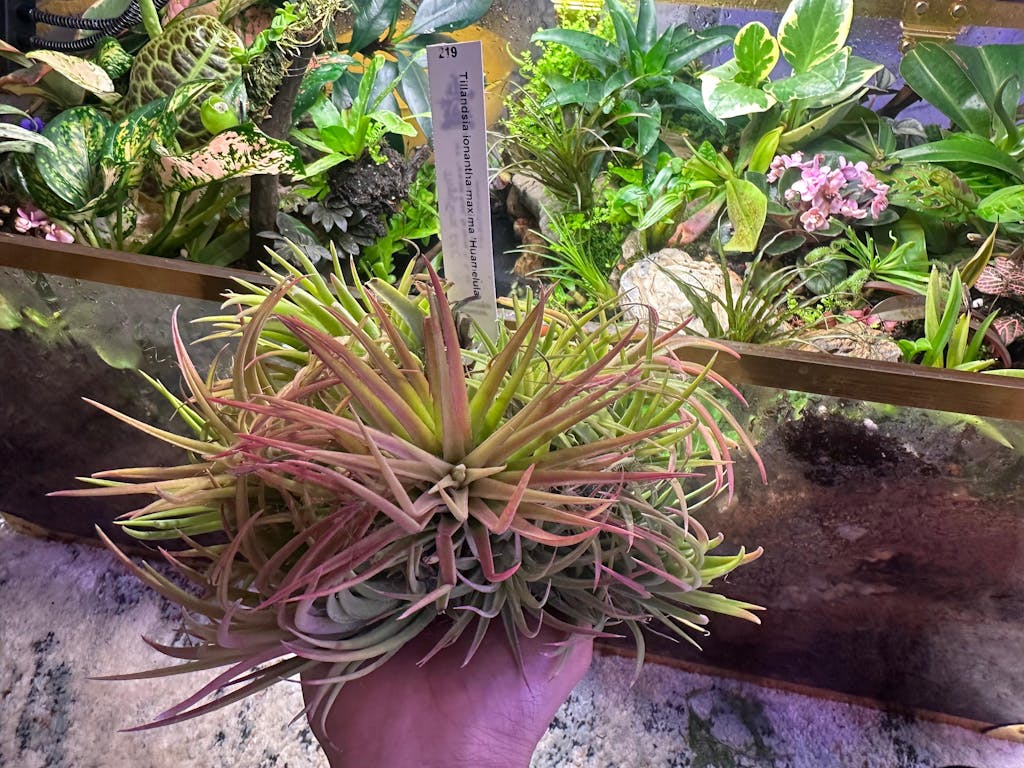
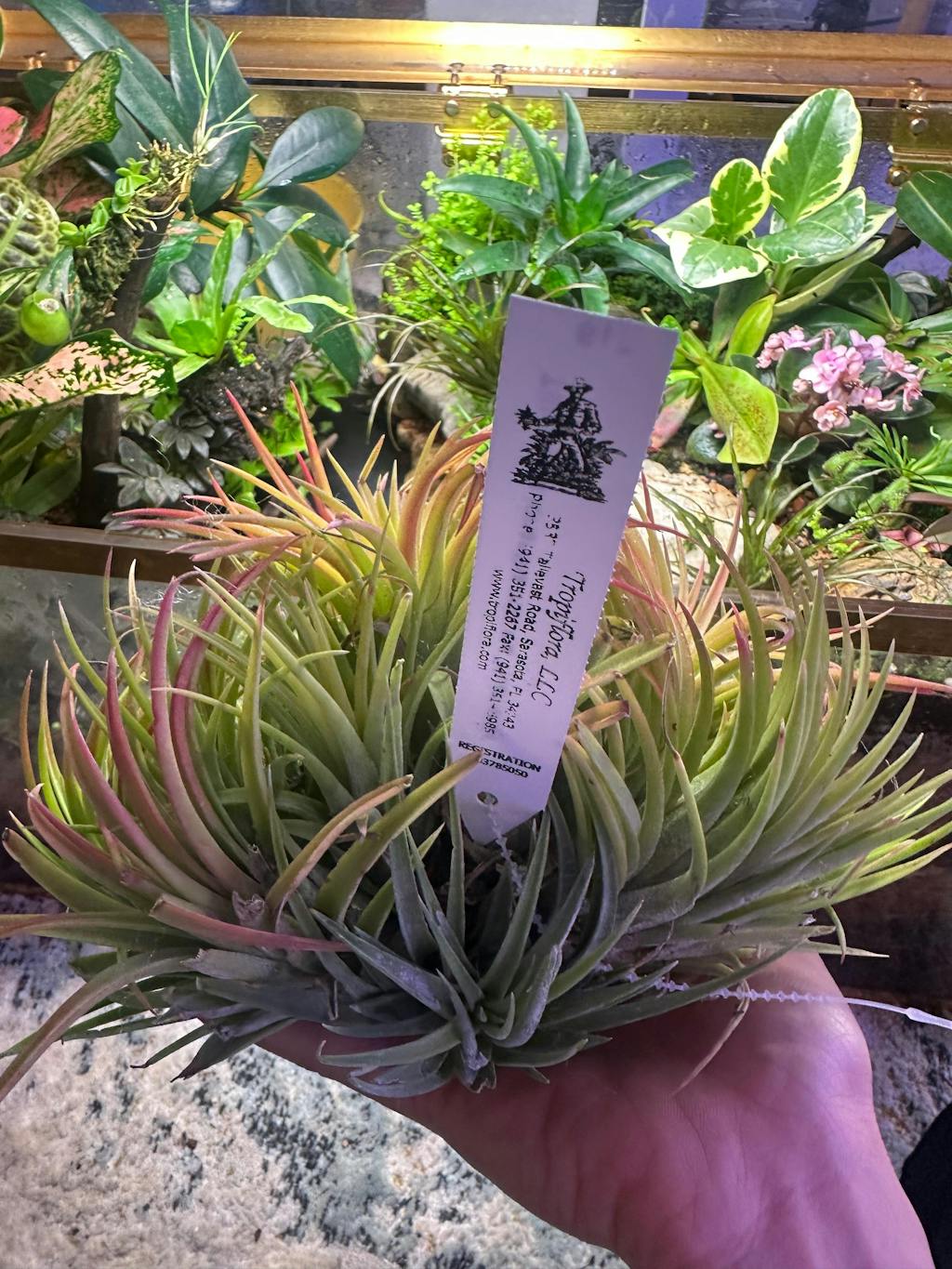
Also known as ‘Huamelula‘, is among the largest and loveliest of the various ionantha forms. It occurs naturally on rocky cliffs above a deep seaside canyon in Oaxaca, Mexico. This form grows up to six inches across in a spreading rosette, and colors a magnificent overall red when in bloom. Large, lovely and easy to grow!
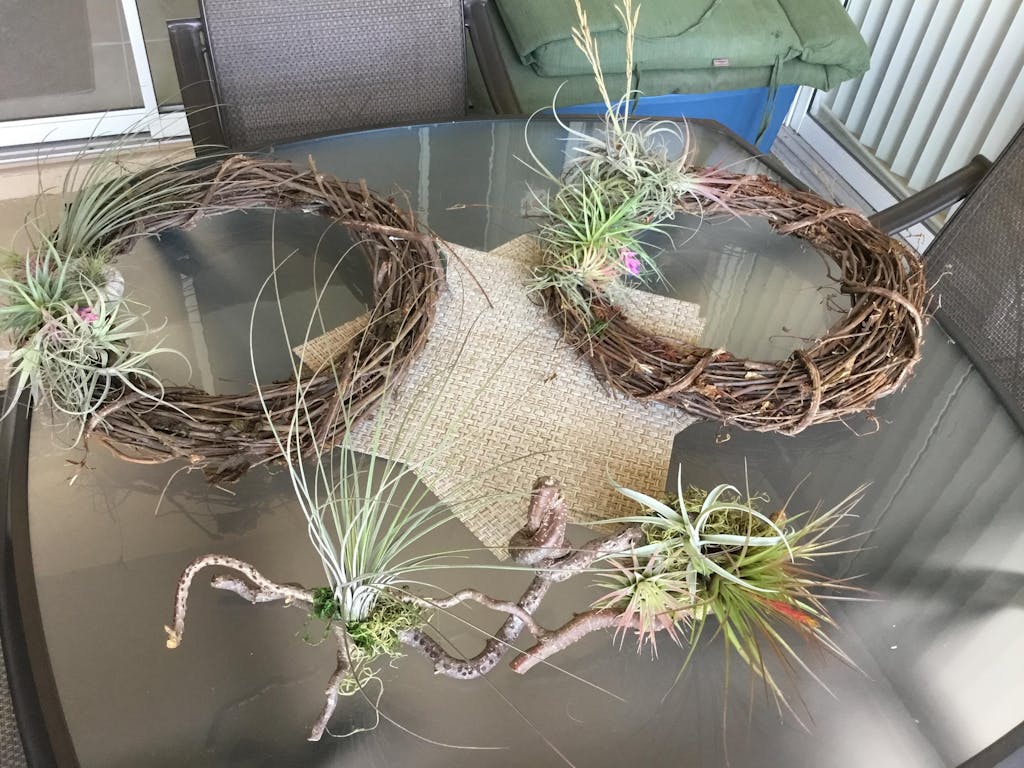
Our art club thoroughly enjoyed creating living art with the assortment of Tillandsia we purchased. They incorporated them into grapevine wreaths and picture frames.
F
Farruco a.
largest one I received
Thank you Tropiflora
Tillandsia concolor 'Cuicatlan'
159
Regular price
$12.50
Sale price
$10.00
Save $2.50
No reviews
A giant form of concolor from Mexico with the same general characteristics as the typical form, but reaching nearly a foot across. A desert dweller with a restricted range, it can be seen growing on cacti and Acacia in the extremely harsh country near Cuicatlan, Oaxaca. Stiff yellowish-green foliage tints reddish in the sun, and a shiny multiple branched spike of yellow to red with pink flowers. An outstanding plant.
Note:It is suggested by the BSI that this is a natural hybrid of unknown parentage. I doubt that. The plants are abundant in habitat but of limited range and they vary little. I believe that this is just a large and attractive clone or possibly form of the species. The ‘normal’ form does not seem to occur within the range of ‘Cuicatlan‘.
An attractive hybrid of (ionantha x chiapensis) by John Arden. As with most ionantha hybrids, it shows very strong characteristics of that species. A very leafy open rosette to about 8 or 10 inches tall with a pinkish blush to the scurfy, silvery leaves. The inflorescence is very colorful, a cluster of bright red branches nested deep in the center, with large, tubular, inky-blue flowers. Very pretty and easy to grow. Likes to be on the dry side.
A colorful hybrid by Bill Timm of (capitata ‘Dominguensis’ x ionantha ‘Fuego’ BT). Like all or nearly all T. ionantha hybrids it most resembles that parent. An upright, vase shaped plant with many tapering, narrow leaves that are red-green with a coating of silver trichomes, but blush deep red towards anthesis. The inflorescence is low in the leaves, a head of deep blue flowers. We raised these here from seed that Bill Timm supplied to us.
Tillandsia Bulk Plants: Tillandsia 'Purple Punch' (Minimum of 10)
5939
Regular price
$4.50
Save $-4.50
No reviews
Our expert tillandsia grower spotted this clone mixed in with our very first batch of Tillandsia 'Eric Knobloch' and has been growing it, aside, for years. We finally separated it from the named hybrid and gave it it's own name. This clone of brachycaulos x streptophylla is darker and more purpleand just slightly smaller in size. An open rosette of light green, curling, silvery dusted leaves form a somewhat bulbous base. An inflorescence that has long, dark lavender blushing bracts and a tight cluster of violet branches rises about 5 inches above the foliage. A handsome, easy to grow and prolific plant.
Regular Retail price is $10.00 per plant. Save $5.50 per plant when you buy in bulk!
Regular price
$20.00
Sale price
$10.00
Save $10.00
No reviews
Paul Isley’s cross of (bulbosa x butzii) is a cute, compact plant with a bulbous base. The leaves are terete and silvery and the inflorescence, borne on a short scape has pink branches. Easily forms clusters and is easy to grow.
Regular price
$30.00
Sale price
$10.00
Save $20.00
No reviews
Jim Irvin’s cultivar of (ionantha v.vanhyningi x caputmedusae ‘Red form’) shows some characteristics of both parents. Overall it is most similar to the caput-medusae parent with a somewhat bulbous base and narrow leaves flaring outward. The leaves are semi-terete but do not contort like caput-medusae often does.
The ionantha v.vanhyningii aspect comes through in the inflorescence which is a short scape of tight branches and rosy red bracts. At anthesis the upper leaves blush reddish and in bright light they can be reddish most of the time.
Tillandsia usneoides This is the famed ‘Spanish Moss’ of the romantic south. Gracing stately trees from Virginia to Argentina, its is a ubiquitous presence in much of the southern U.S. and especially here in Florida.
The form we sell is our native form, long silvery strands, fluffy and fresh, with fragrant green flowers when it blooms. We grow some in greenhouses, but much of our stock is harvested in the many trees right on Tropiflora property. We clean it of twigs and leaves and only rarely treat it with insecticides for shipment, by request.
Forget about the red bug stories you may have heard about ‘Spanish Moss’, it’s a myth. Great for that special tropical look in your trees, for use with reptiles, as decorative mulch on indoor plants and more. Keep in a breezy, partially shaded place for best results and water well once a week. Feed occasionally if kept indoors.
Note that the photo below is a clump just over 3 feet long and is about a pound (actually just under).
*PLEASE NOTE - We are no longer allowed to ship this item to Japan
I bought both the greenhouse grown and the harvested from trees bunch. The greenhouse form was beautiful, soft and almost 3' long. The harvested bundle was huge. I Love it so much. Thank You.
Tillandsia 'Kay Jay'
7274
Regular price
$12.50
Sale price
$10.00
Save $2.50
No reviews
A cultivar of (stricta x aeranthos) by Woods. It is a medium sized plant to about six inches across with narrow, silvery-green leaves. The inflorescence is very colorful, dark pink bracts and deep, inky-blue flowers. Grows easily mounted and will form attractive clusters.
Our expert tillandsia grower spotted this clone mixed in with our very first batch of Tillandsia 'Eric Knobloch' and has been growing it, aside, for years. We finally separated it from the named hybrid and gave it it's own name. This clone of brachycaulos x streptophylla is darker and more purpleand just slightly smaller in size. An open rosette of light green, curling, silvery dusted leaves form a somewhat bulbous base. An inflorescence that has long, dark lavender blushing bracts and a tight cluster of violet branches rises about 5 inches above the foliage. A handsome, easy to grow and prolific plant.
A natural hybrid of (flexuosa x funckiana) that we collected in Venezuela in the late 1990’s. This plant is from a completely different area than the one described by Gouda in 2002, but it likely would be considered the same taxa. Our plant is from the state of Carabobo on the old road from Valencia to Puerto Cabello, a long distance from the Merida locality of the other. We found ours growing on a rock, in light forest in partial shade. The Tillandsia flexuosa and funckiana in this area are quite different looking than the ones near Merida which is much higher in altitude and much drier.
An interesting plant with long, stiff leaves along a caulescent stem, silvery green in color, clump forming. The inflorescence is a thin scape no higher than the foliage, with large flowers of deep rose red that are tubular with flaring petals that recurve at the tips. A very interesting plant that leaves no doubt about its hybrid origins.