
4789
We first got this plant from a friend under formula, before the name ‘Nugget’ was given and registered. This is a cultivar of crocata x duratii by Barry Genn, both species highly fragrant but the hybrid of the two barely so. That said, it’s beautiful!
Our plant originally was quite small and ‘wimpy’ with few leaves and kind of scrawny looking. Under the care of Veronica our Tillandsia grower, it has become a much larger, robust plant with a nicely branching inflorescence and curling, silvery leaves.
The flower color is buttercup yellow, kind of surprising with the normally dominant duratii in the mix, but all better for it. We have found that if kept well fed and in good light and air circulation, the plant is vigorous and will produce offsets. Different and attractive.
8499
An interesting cross of kegeliana x rothii for which we have little information. The plant most certainly show strong influence of the rothii parent with an open rosette shape of wide, fairly stiff leaves and a branched inflorescence of inflated branches. The kegeliana doesn’t manifest itself much but definitely makes the plant look a lot different than a pure rothii. The flowers are white.
*VIPP plants are Offsets
2669
This cute little caulescent plant is a cross of (tectorum x paleacea) reaching about 6 to 8 inches long, with 2 inch fuzzy silver leaves. Not as fuzzy as the tectorum parent, but still very fuzzy. A very prolific, fast-grower, producing many offsets and forming clumps fairly quickly. The scape is about 6 inches long with purple flowers. Grow it hanging from a string or mount it. A very easy ‘confidence builder’ for beginners, but a nice plant for any collection.
Plant came as advertised and I was satisfied with the clump that was sent to me, very healthy plant.
So many wonderful healthy plants! Love the huge varieties and blooms!
331
This species from Mexico and Central America is an upright growing plant to 12 inches and has a simple or occasionally branched, lanceolate inflorescence of red and yellow. Usually epiphytic, sometimes lithophytic in nature, it is easy to grow and a faithful bloomer with leaves that blush reddish in strong light. Suitable for terrariums.
7292
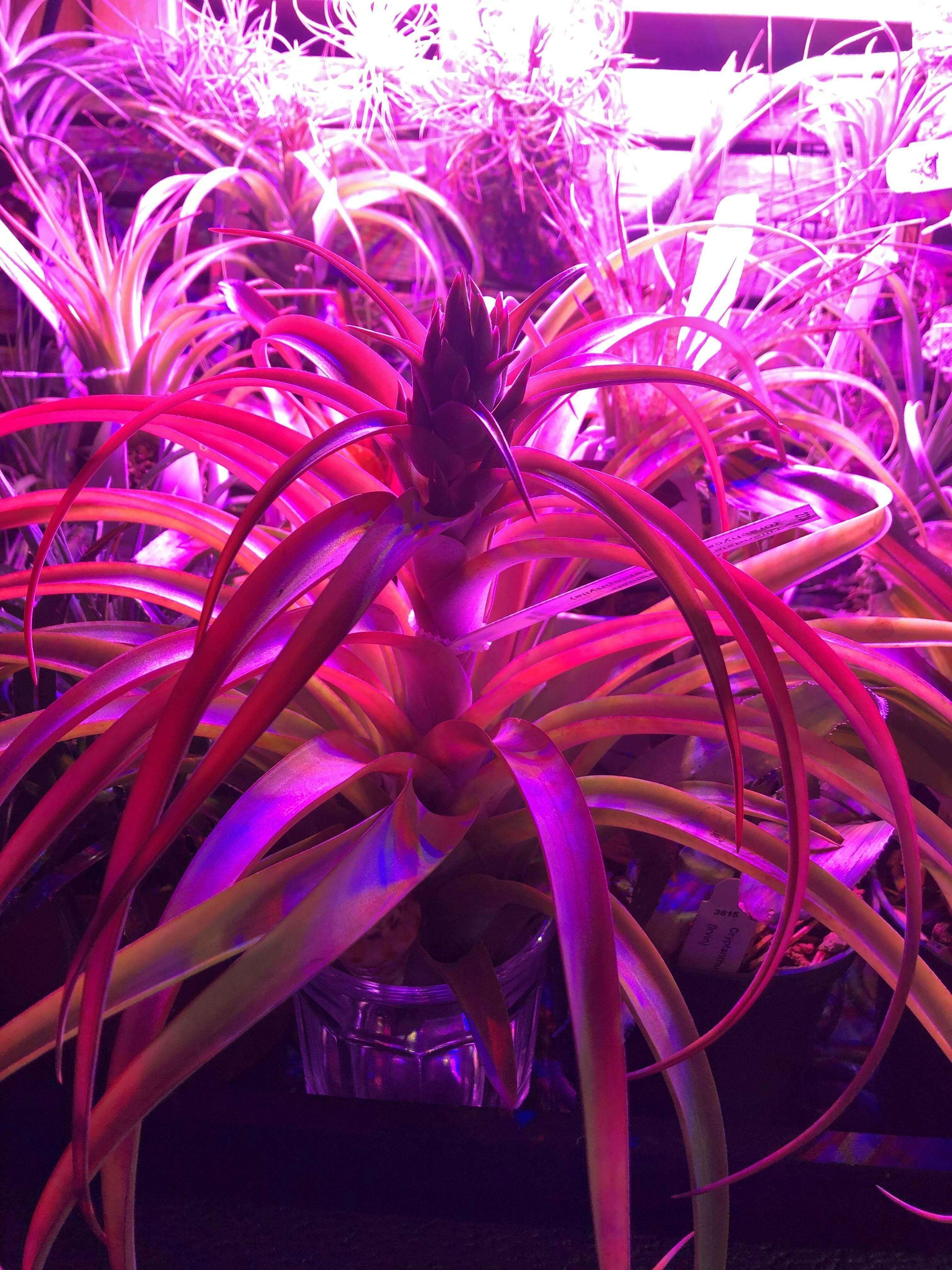
A handsome hybrid of (capitata x fasciculata ‘Magnificent’) by Steve Correale with a 20 inch spreading rosette of fasciculata-type foliage, stiff and rather narrow, reddish and showing some banding on the undersides. The inflorescence is a red spike of short branches reaching about 10 inches tall.
198
Native to the Andes of Venezuela, this cliff dweller is one of the jewels of the genus. A caulescent plant forming large clumps in just a few years, has fine, needle-like leaves about 3/4 inch long which flush red when blooming. The flower is a single, red, slightly flaring tube. A clump in bloom is a sight to behold! Flowers at various times throughout the warm months. A must for any collection, simply hang from a wire, grow it bright, water and fertilize frequently, allow to dry quickly.
3292
A colorful hybrid by Bill Timm of (capitata ‘Dominguensis’ x ionantha ‘Fuego’ BT). Like all or nearly all T. ionantha hybrids it most resembles that parent. An upright, vase shaped plant with many tapering, narrow leaves that are red-green with a coating of silver trichomes, but blush deep red towards anthesis. The inflorescence is low in the leaves, a head of deep blue flowers. We raised these here from seed that Bill Timm supplied to us.
4984
A large growing clone of the species with stiff, gray leaves that have an almost glaucous look. The inflorescence is tall, narrowly branched and light yellow in color. A lithophyte or rock dwelling form that lives in southern Mexico. An easy to grow, hardy species.
6921
A smallish species of Tillandsia that grows on a long stem. The narrow, stiff leaves are 2 to 3 inches long spaced along the stem and taper to a point. The overall color is dark purplish with a silvery tint. The inflorescence is a 2 inch scape with bright pink bracts and flaring blue flowers. Clumps are easily formed and once a clump forms, the plants can be suspended from a string for cultivation.
Native to Rio Grande do Sul in Southern Brazil, it has a strong resemblance to T. aeranthos though it must be significantly different enough to deserve species status. Our plants came originally from the collection of Elton Leme.
I received my first order from Tropiflora today. I ordered 14 airplants, and all 14 were winners. They were packed in foil with a heating pack since they were traveling through cold weather from Florida to California. Each plant was individually wrapped in newspaper, and it felt like Christmas, opening my purchase. Thank you for a job well done.