Regular price
$35.00
Sale price
$25.00
Save $10.00
No reviews
A hybrid that we got from a friend some years ago that is of unknown provenance, to us anyway. It has “the look” of a Steve Correale hybrid but we do not know for sure. This cross was also done by Paul Isley and his cross is named Tillandsia ‘Mr. Mal Mele’, but it is not the same as our plant.
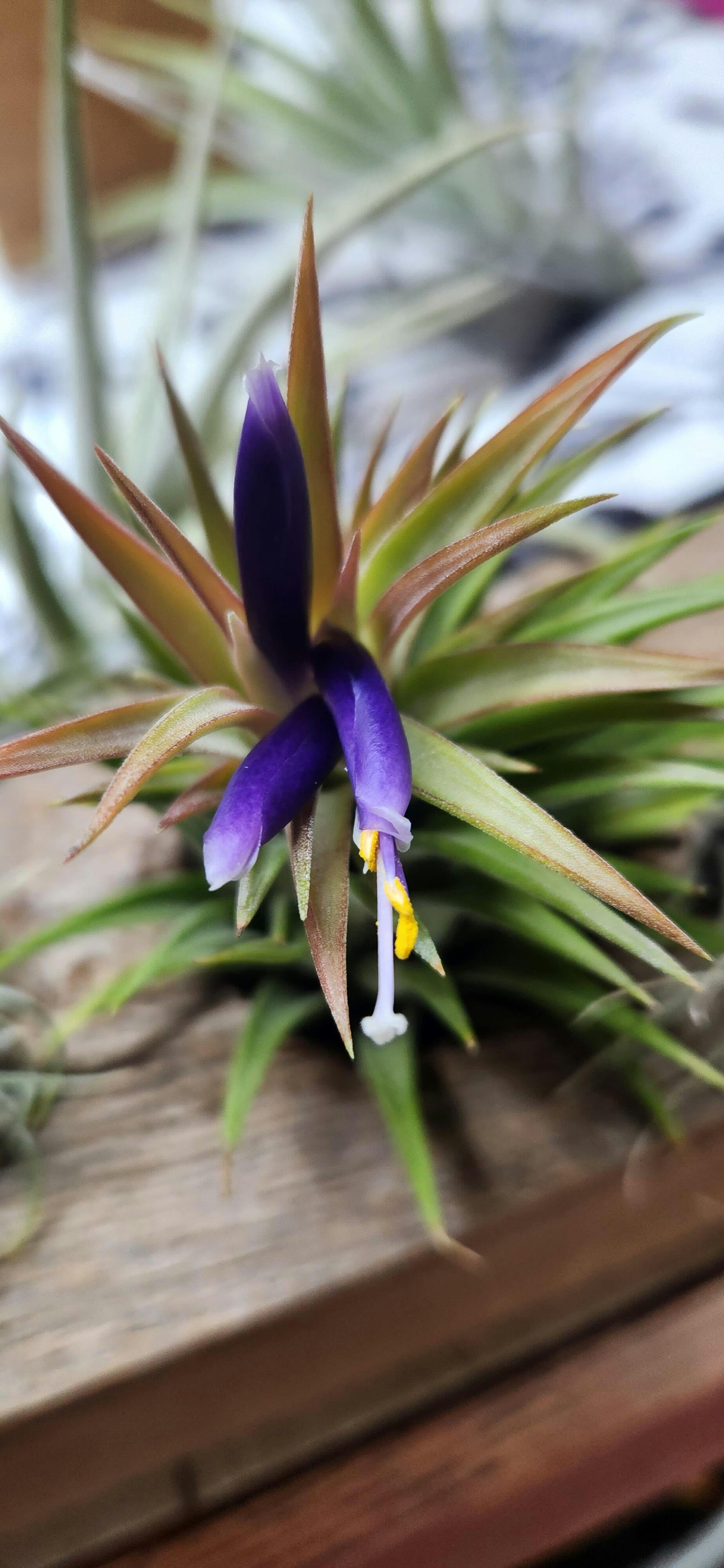
Ours has broad, recurving, silvery leaves and a slightly bulbous base. The leaves blush pinkish on the upper part of the plant at anthesis. The inflorescence is about as tall as the body of the plant overall, with long scape bracts. It bears 6 or more branches that are held upright at a 45-degree angle to the scape. Floral bracts are bright red with some silvery trichomes. Flowers are violet. A very attractive plant with a long-lasting inflorescence.
A Mexican plant with very stiff leaves in an open rosette of 6 to 8 inches. The leaves are yellowish, blushing reddish in strong light or full sun and it produces a shiny red to yellow-green, branched inflorescence with pink flowers. Easy to grow, preferring conditions on the bright and dry side. Can be suspended from a string or mounted on wood, cork, stone or other substrate. Suitable for dry terrarium use.
The largest form, native to the desert valleys of central Ecuador. Often found growing as a saxicole or on cacti, this form differs from the typical in being much larger, with a bulbous base that can reach three inches in diameter and strictly upright, fine reddish-brown leaves. The inflorescence is longer, exceeding the foliage by several inches, branched and producing many yellow flowers which have a mild fragrance. An easy species to cultivate. Grows into a nice slightly stoloniferous cluster and does well mounted or potted in a very loose, well-drained media.
A caulescent species from Brazil with dark, recurved greenish leaves on a 6 to 8 in stem. The inflorescence is a simple red spike which stays in color for months. Forms large clusters and does well mounted.
Regular price
$110.00
Sale price
$75.00
Save $35.00
No reviews
A real oddity. Showing characteristics of both parents, the influence of duratii is obviously stronger. A caulescent plant, with narrow, succulent silvery leaves like duratii, but leafier and more of a rosette shape like stricta.
Unusual for the cross, this same cross; Tillandsia edithae x albertiana, has been made several times in the past and is registered under at least two names. Both however have red flowers, as one might expect with a cross of two red-flowered parents. This one has large purple flowers, silvery pink bracts and nice silvery leaves in a leafy, upright rosette. This plant freely produces many offsets.
This is the same plant in every way as the regular form of the species, except much, much larger. Reaching up to 12 inches in diameter, with stolons of 6 to 8 inches, it is an impressive plant. The many leaves are silvery, with an 8 inch bright red spike with blue flowers. This rare form is restricted to the north central Pacific coast of Ecuador. Grow mounted, bright as with most Tillandsias. Please note that this species was described as and was considered a Vriesea until the recent DNA studies prompted a realignment to the genus Tillandsia.
Came on time and a nice healthy plant always satisfied with Tropiflora.Now to make it bloom.
Tillandsia extensa
449
Regular price
$15.00
Save $-15.00
No reviews
Tillandsia extensa, a terrestrial from the upper slopes of the Rio Chancay has red leaves when grown in full sun. The infloresence is a massive, multi-branched panicle that is sometimes used a Christmas tree locally. Mature at about 24 inches the species seems to adapt well to cultivation and may be grown potted or mounted.
This is an unidentified species that is at least similar to fasciculata and with a ‘Pink & Green’ inflorescence. We have had this for many years and in the interim have lost the locality data for it. We believe that this was originally from Mexico, but may be mistaken. Too bad, because this data is important when trying to identify plants. At any rate, this is a nice and colorful, fairly large-growing Tillandsia worthy of space in your collection!
A large-growing Tillandsia that fits closer with fasciculata than anything else, with silvery-gray leaves to 24 inches long in a very large and full rosette. The inflorescence is massive, reaching well above the foliage on a thick scape, supporting a head of up to 20 fat bright-red bracts up to 8 inches long and an inch thick.
The inflorescence lasts in good color for over a year. A likely natural hybrid of fasciculata x compressa that we got from Jamaica over 40 years ago.